
The Photograph of Christ
For God, who said, "Let light shine out of the darkness", has shone in our hearts, that we in turn might make known the glory of God shining on the Face of Christ." 2 Cor. 4:6
During an exposition of the Holy Shroud of Turin in 1898, an amateur photographer, Secondo Pia, a lawyer by profession, in developing a photograph of the Shroud was startled to see before him on the negative a wonderful image of the Face and Body of Christ. This amazing discovery was confirmed some thirty years later when the Holy Shroud was again photographed by Giuseppie Enrie, a professional photographer.
After nineteen centuries the Body of Christ is photographed! Science, unbiased and with precision, has discovered the image. The unsatiated desire of the ages to behold the Christ has finally been fulfilled.
"That which no one even dreamed of, the breathless secret of our hearts, has been unveiled by the impressionable lens and the photographic plate, i.e., from two objects upon which as everyone is aware, suggestion of any sort (be it phantom or false image) has no effect.
The photograph itself is evidence in its own behalf, and evidence is the greatest philosophic proof. The marvelous technique of Enrie's photograph is practically a great new discovery in itself: it is the photograph of a soul, the true Image of Christ." (Dr. Hynek)
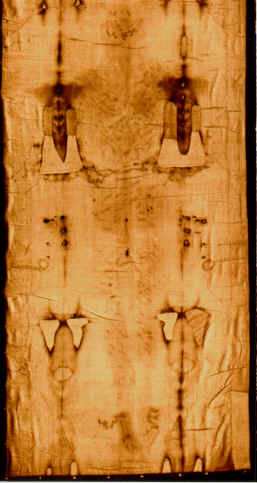
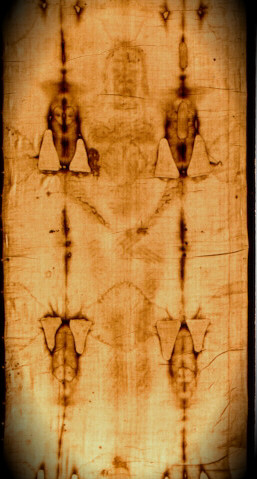
Upon the Shroud one can see the entire Body of Christ and the marks of the Passion, as described by the Gospel. The swellings and the bruises dealt to the Sacred Face are evident: the wounds caused by the Crown of Thorns are visible together with the stripes of the Scourging: His hands and feet clearly manifest the piercing of the nails, finally the wound made by the lance in his side is visible.
"Most assuredly our Blessed Savior, not content to remain with us beneath the Eucharistic veils, also chose to bequeath us the image of His Sacred Body at the very instant He completed the work of our redemption. Therefore, in a perfect way, he guided the physical and chemical reaction of various substances to bestow upon us the impressions on the Holy Shroud. We recognize therein, the Hand of Him who has made all things." (Fr. Alessio, Passionist)
Yves Delage, an unbelieving scientist and liberal thinker, upon examination of the discoveries relative to the Shroud, at the Sorbonne of Paris in the solemn reunion of the Academy of Sciences did not hesitate to state the following in the presence of the famous Berthelot, himself a liberal thinker: "It is Christ who has imprinted Himself upon the burial sheet. And if it is not Christ, then who can it be? Perhaps one condemned to the same death on the cross? But how can anyone explain the majestic expression that is written upon this Face?"
"Notwithstanding the efforts of the arts throughout the ages to depict the Face of our Divine Lord and Savior, Enrie's unpretentious photograph stands alone as the masterpiece of the greatest innate value in the representations of Christ. For us, it shall always be the most perfect portrait of Christ, infinitely superior to all others, of such inexhaustible multiform beauty as to make it impossible for all the arts, even in their most beautiful representation, to depict the varied details and virtues of this photograph.
"There is something magnificent beneath the features of this unpretentious inanimate photograph. Here Christ is in the dignity of His Divine messianic mission, the object of perpetual contemplation, the font of innumerable graces, the most precious of treasures. In the silence of death, we see the life that impoliticly awaits the moment of triumph and the proximity of the Resurrection. This revealing photograph is the true unadulterated and only Image of the Savior that quenches our innermost desire and our most ardent love.
"Finally, thanks be to God, we possess the true, authentic and at the same time, the marvelous portrait of Christ!"
Dr. Hynek concludes: "Friends, in what manner can someone intensify love towards a loved one: whereupon a person thinks of another, remembers and remains faithful in life and in death?
"What vanquishes time and space? What greater joy can one give to one's relative, a friend to his friend, a lover to a loved one, than to send him an image that represents oneself, i.e., one's own portrait?
"And now in our troubled times, the Lord has dealt with mankind by means of a human custom. Through the Holy Shroud, He has bequeathed to us His Holy Face, to give us courage and assistance in peril, in need, in suffering, and to kindle our hearts so that they may become inflamed with inexhaustible love for Him."
"Peace be to you! My peace I give you." Jesus' greeting today is the old familiar one, sacramental on His lips. His message of peace takes on its true meaning for us as we gaze with faith and love on His Holy suffering Face. Hereon is written not the peaceful ecstasy of angelic bliss. The Face we contemplate is a human Face even as our own, and more! It is the Face of one who has suffered even as we, and infinitely more than we.
Whence His peace? Jesus Himself tells us: "I have not turned My Face away ... from suffering. My peace lies in the Vision I hold beyond it!" His eyes are closed to the physical, material and moral instruments of His sufferings, but His intense inward gaze is fixed on a loving Father, our Father.
As we contemplate that Face, the "Power which goes out" from the Savior bathes our souls in the peace of the Vision that is His, freeing our spirits from the passing turmoil of time and earthly conflict to dwell in the silence of that inward gaze, in the peaceful knowledge of God's ever-present love and will for us through the providential arrangement of our lives.
Suffering, in one form or another, is on earth the lot of us all; A lot Christ freely willed to share. Its solution and accompanying peace lie not in the frantic effort to escape pain but in the acceptance of it, suffering in union with the suffering God-Man and with His clear inward gaze upon God. In this manner we shall pass, in faith, through the vicissitudes of our earthly existence to the fullness of peace in the Beatific Vision where the Glorious Face of Christ and the unveiled Godhead will delight our loving gaze eternally.
"Did not the Messiah have to undergo all this so as to enter into His glory?" (Luke 24:26)